From Prompt Engineering to Context Engineering for Business Results

From Prompt Engineering to Context Engineering for Business Results
- In Stock
5-module
series
5
weeks
5 hours
per week
What you’ll be able to do after 5 weeks
Learn how to turn individual AI prompts into clear, reusable workflows that support real work. Each module helps you build practical tools you can apply to reports, research, emails, documents, planning, and other daily tasks.
Recognize when a prompt is not enough: Identify when AI needs more background, examples, or instructions to give you a useful result.
Build structured context maps: Organize instructions, reference materials, examples, and other important details, so AI has the information it needs.
Create reusable AI resources: Develop templates and organize them into a context library that you can use for future projects.
Design reliable AI workflows: Connect several steps into a process with clear starting information, expected results, and next steps.
Manage longer, more complex work: Learn how to help AI keep track of important information during a task that takes several steps or conversations.
More measurable business impact: Compare your results before and after building your workflow. Then explain how the new process improved the speed, quality, or consistency of your work.
Why take this prompt engineering course?
You may already know how to write prompts but still spend time repeating instructions, adding missing details, or correcting results that missed the mark. Move beyond simple chats and query work to deliver generative outputs that are repeatable and personalized to your goals.
Context engineering is the practice of giving AI the instructions, background, examples, and other information it needs to complete a task. This generative AI course shows you how to bring that information together so AI can support your work more reliably.
You will practice realistic workplace situations, complete guided activities, and build connected assignments. By the end of the course, you will have practical tools and examples of your work that show what you can do.

Save time on setup
Build reusable context and templates, so you do not have to explain the same background, goals, and requirements each time you start a task.

More reliable AI results
Build on your prompt-writing skills by adding helpful examples, reference materials, and other context for more useful and consistent results.

Build reusable workflows
Turn individual prompts into a repeatable AI workflow that can support reports, research, emails, documents, and planning.

Show business value
Compare your results before and after building your workflow and explain how the new process improved your work in a clear business impact case study.
Once you've mastered prompt and context engineering and designing repeatable workflows, you'll be well-prepared to begin building more agentic workflows in more advanced DVP courses like Applied AI.

This image is AI generated
Meet your AI Learning Coach: Marcus
Marcus is a Context Engineering Coach and virtual instructor for From Prompt Engineering to Context Engineering for Business Results. He helps working professionals move beyond one-off prompting by showing them how to design the complete environment around an AI task. His guidance focuses on practical elements such as standing instructions, trusted reference knowledge, examples, working memory, reusable templates, quality criteria, and workflow handoffs. Rather than focusing on software engineering or model development, Marcus helps learners make AI-supported work more reliable, repeatable, and valuable in real business settings.
How Marcus supports you
As a virtual instructor, Marcus brings a structured and practical approach to complex AI concepts. He explains context engineering in clear business language and connects it to familiar workplace activities such as research, reports, analysis, planning, communications, and documentation. Through testing and comparison, he helps learners identify why an AI output succeeds or falls short and determines whether the instructions, sources, examples, memory, or evaluation criteria need improvement.
Marcus’s goal is to help professionals build AI practices they can confidently apply beyond the course. He emphasizes reusable structures, measurable business impact, and responsible AI practices, including verification, source awareness, transparent assumptions, and human judgment. By helping learners develop solutions they can refine, reuse, and share with others, Marcus supports a practical transition from simply writing better prompts to designing stronger systems for AI-supported work.
Celebrate your success
After completing the course, you’ll earn a Certificate of Completion from the United States Artificial Intelligence Institute (USAII®) and digital badge. Share your credential and portfolio-ready course assets with your network, your team, and future employers to demonstrate your context engineering AI skills.

Built in partnership with USAII
DeVryPro developed this course in partnership with the United States Artificial Intelligence Institute (USAII), an independent international institute focused on AI education and certification. USAII brings specialized AI knowledge and an industry-informed framework, while DeVryPro provides a practical online learning experience designed to help you apply new skills at work. After completing the course, you will earn a Certificate of Completion from USAII and a digital badge.
From Prompt Engineering to Context Engineering for Business Results modules
Five modules. Real workplace skills. Built to help you move from one-time prompts to reusable processes that produce more consistent results.
Learn why one prompt may not include enough information for a task you complete often or a project with several steps. Explore the basics of context engineering and see how better background information can make AI-generated work more useful, accurate, and consistent.
You leave with → A simple way to spot missing information and decide what AI needs to complete a task
Learn how to organize system instructions, reference knowledge, examples, and working information into a structured context map. Then create a context map that shows what AI needs for a real workplace task.
You leave with → A context map you can use for a task you complete more than once
Turn instructions, materials, and examples you use often into reusable templates. Organize them into a context library so you can find and use them again and again without starting over.
You leave with → Reusable templates and an organized collection of information for future work
Connect your prompts, background information and supporting materials into a step-by-step process. Learn what information goes into each step, what results should come out, and what needs to happen next.
You leave with → A documented AI workflow architecture for a real business process
Apply your context and workflow design to a workplace process. Compare results before and after adding structured context, evaluate changes in efficiency, quality and consistency, then communicate your findings through a clear, data-informed case study.
You leave with → A portfolio-ready business impact case study that demonstrates the value of your AI workflow
Continue your learning path
If you’re exploring this AI course, you may also be interested in additional courses that can support your growth and broaden your skill set.

New to generative AI?
Learn the foundations of generative AI, explore common tools, and build the prompt-writing skills needed to use AI effectively in your work.
Ready to build broader AI solutions?
Expand into more advanced applications involving multiple tools, teams, agents, agentic workflows, and business use cases.
Interested in a degree program instead?
Explore undergraduate and graduate business, technology, and digital health programs offered by DeVry University and its Keller Graduate School of Management.
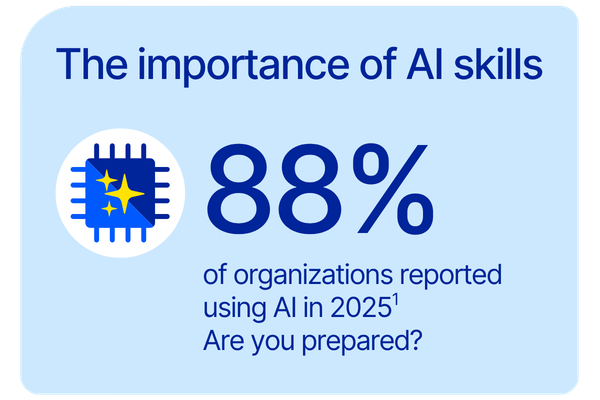
¹Stanford Institute for Human-Centered Artificial Intelligence | 2026 AI Index Report